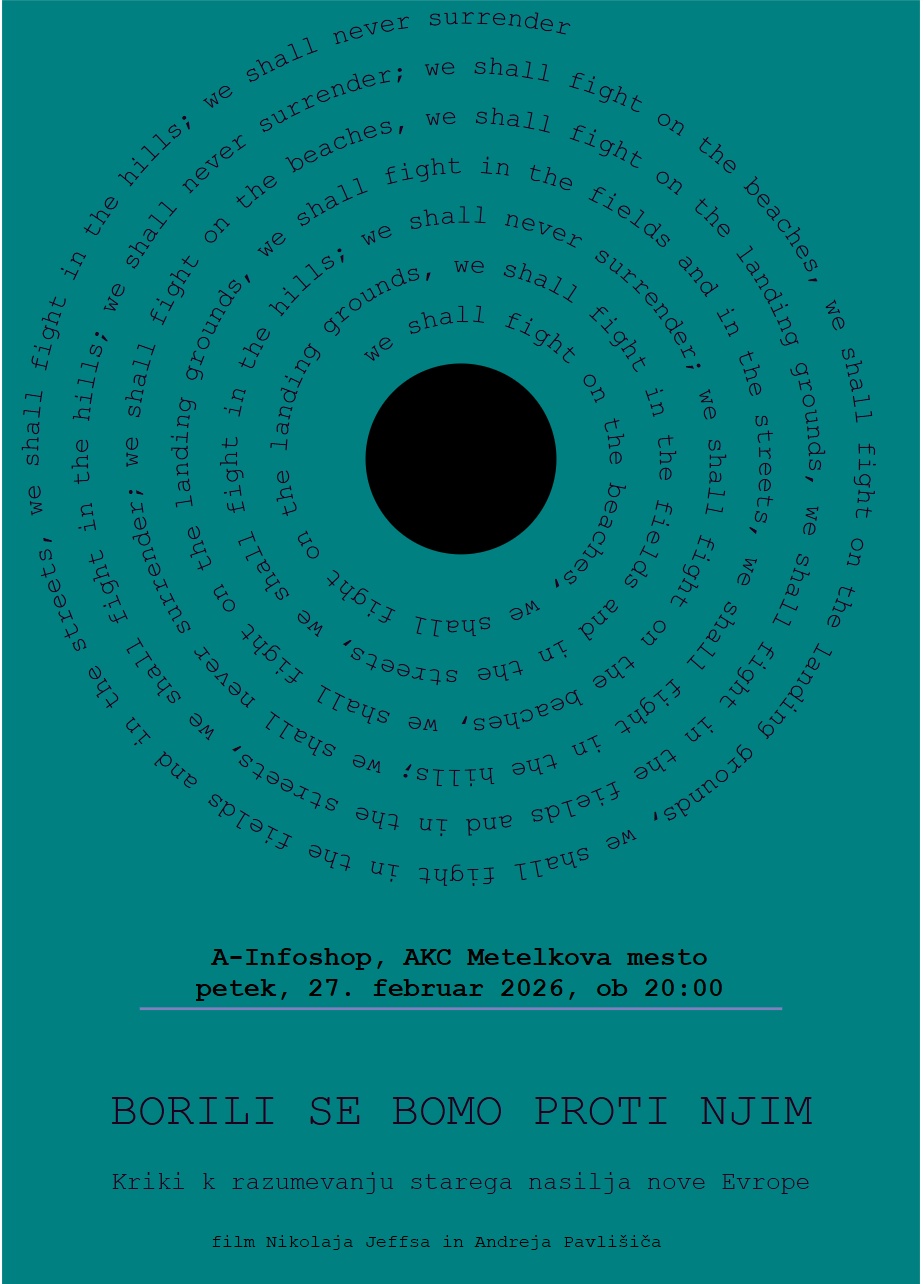
Film: Borili se bomo proti njim: kriki k razumevanju starega nasilja nove Evrope (2004)
// A-Infoshop – 20 let //
Filmsko-pogovorna infokafana:
Borili se bomo proti njim: kriki k razumevanju starega nasilja nove Evrope, 2004, slovenščina, barvni, digitalni, 45'10''
Scenarij in režija: Nikolai Jeffs, Andrej Pavlišič
V anarhističnem socialnem centru A-Infoshop nadaljujemo s sproščenimi, a vsebinsko polnimi večeri. V sklopu serije dogodkov, s katerimi obeležujemo 20 let neprekinjenega delovanja prostora, (skoraj) ponavljamo dogodek iz leta 2008.
Ogledali si bomo klasiko domačega in mednarodnega filma Borili se bomo proti njim: kriki k razumevanju starega nasilja nove Evrope. Povod za nastanek tega dokumentarnega filma je bil dvojen. Prvi je bil težnja po radikalizaciji filmskega jezika do te mere, da bi bil uspešno kos nalogi premagovanja odtujitve od zgodovinskih in družbenih pogojev delovanja vsakega posameznika ali posameznice. Drugi povod, do neke mere povezan s prvim, pa je bil tedaj bližajoči se vstop Slovenije v Evropsko unijo in z njim povezane propagandne ofenzive.
Borili se bomo proti njim: Kriki k razumevanju starega nasilja nove Evrope je nastal v obdobju zadnje zlate dobe neoliberalne ideologije, v času, ko je bilo kolonialno in drugo nasilje vsaj za ne posebej radovedno spremljevalko družbenih dogajanj skrivano pod plastmi zgodovine in pozabe precej bolj, kot je to danes, ko je povsem nazorno, otipljivo in vsakdanje prisotno. Medtem ko obljube in obrazi vladajočih iz tistega časa večinoma že dolgo počivajo na smetišču zgodovine, to ne velja za pričujoči film. Ta je zdržal test časa, še več, valovanje zgodovine je lucidnost in moč njegovih podob zgolj še okrepilo.
Lagali bi, če bi rekli, da je bil film preroški. To bi bil nematerialistični pogled na gradivo filma, v katerem so izluščene bistvene zgodovinske tendence ter namere časa v katerem je nastal. Film namrel za svoje vsebinsko izhodišče jemlje zločine, na katerih je utemeljena sodobna Evropa in pretresljivo pokaže, kako so ti z neprekinjeno vezjo povezani z zločine, ki so ravno v teku in v katerih pogosto – zavestno ali ne – sodelujemo tudi sami in ki pomembno vplivajo na naše lastne pogoje življenja. Preko bolečih dokumentov, neprijetnih podob in filmsko potujenih pripovedi pokaže jasno kontinuiteto med danes v ljudsko folkloro prenesenih zgodovinskih zločinov, kot so preganjanje, denimo, žensk v obliki »lova na čarovnice« in med sodobnimi praksami strukturnega in pogosto legalnega nasilja, denimo homofobije, množičnega zapiranja velikih delov domnevno »motečih« populacij ali kolonialnih podvigov različne intenzivnosti na drugi strani. Med celo vrsto dramatičnih prizorov, ki ne delujejo prav nič zastarelo, so tudi anticipacija vrnitve političnih projektov, ki so v času nastanka filma v splošno javnosti veljali za davno presežene, kot so, na primer, fašizem oziroma nacizem in vulgarni kolonializem. Zlovešča napoved, da si bodo le-ti nadeli bolj sodobne, živahne barve se dandanes uresničuje s tako bliskovitostjo, da so žal prepogosto vzeti kot neke vrste naravna dejstva, ne pa rezultat delovanja družbenih sil. Nič čudnega torej, če gledalec ali gledalka iščeta v domnevno mirni barvitosti posameznih scen filma, uteho in beg pred dokumentariranim permanentnem izrednem stanju na katerem je Evropa utemeljena. Tu je na delu ravno vladajoča ideologija, ki ju ujame in vzame za talca stalno odvijajočih se osvajalnih projektov, ki se razpirajo od kolonizacije uma do zavzetja teritorija realnega nasilja nad drugim.
Borili se bomo proti njim: Kriki k razumevanju starega nasilja nove Evrope je učna ura mišljenja z bolečino in praktična vaja v boju zoper ukinjanje zgodovine. Dramatična filmska pripoved se razpira v soočenje z lastno odgovornostjo v luči zgodovinskih zločinov.
Film je nastal na obrobju filmske industrije, a je na svojem pohodu skozi domače in mednarodne festivale, avtonomne prostore in filmu namenjene institucije zgradil lojalno publiko in otipljivo tudi na sodobne umetniške prakse v domačem prostoru. Med drugim je bil na rednem programu Kinoteke, edini prispevek iz Slovenije na festivalu filma v Zagrebu, večkrat predvajan v Kiberpipi, scenarij je ponatisnjen v prvi številki slovite revije Kino!. Bil je relativno bogato in kritično recenziran (Likovne besede, Radio Študent, Dialogi), uvrščen je bil tudi v več izborov (top 5 filmov leta 2004 po izboru revije Polet, del retrospektive Pogoji (in) možnosti v Slovenski Kinoteki...), projekcije so bile v Novi Gorici, Kopru, Črnomlju, Mariboru, Avtonomni tovarni Rog.... Zabeleženi so bili močni indici, da je ob svoji premieri v Galeriji Alkatraz (AKC Metelkova mesto) vzbudil tudi radovednost oseb z uradnimi pooblastili. Film je kmalu postal klasika, s tem pa je bila potrjena tudi politična in družbena moč filma oziroma umetnosti na sploh, je pa res, da bo šele odprtje uradnih arhivov in zabeleženj omogočilo temeljit vpogled v pretrese v umetniškem in političnem svetu, ki bi jim utegnilo biti možno slediti nazaj do tega prelomnega filma.
Projekcijo osrednjega filma bo dopolnila projekcija serije treh kratkih filmov Zgodba o bogu, Biti vladan in Skromen prispevek h kritiki blagovnega fetišizma. Vsi filmi so v slovenskem jeziku.
Prisrčno privabljeni!
// 20 Years of A-Infoshop //
Film and discussion infocafé:
We shall fight them: howlings towards the understanding of the old violence of the new Europe, 2004, color, digital, 45’10''
Screenplay and direction: Nikolai Jeffs, Andrej Pavlišič
The anarchist social center A-Infoshop, continues its relaxed, yet content-packed evenings. As part of a series of events celebrating 20 years of continuous operation of this space, we are (almost) repeating an event from 2008.
We shall thus watch a classic of domestic and international film, namely, We shall fight them: howwlings towards the understanding the old violence of the new Europe. The reason for the creation of this documentary film was twofold. The first was the desire to radicalize the language of film in general and to the point that it would successfully cope with the task of overcoming the alienation from the historical and social conditions that each individual lives with. The second reason, and to some extent related to the first, was Slovenia's entry into the European Union and the propaganda offensives associated with this entry.
We shall fight them: howlings towards the understanding the old violence of the new Europe was made during the last golden age of neoliberal ideology, at a time when colonial and other violence was hidden under layers of history and oblivion, at least for the not particularly curious observer of social events, and much more than it is today, when it is completely clear, tangible and present every day. While the promises and faces of those in power from that time have mostly long since come to rest in the dustbin of history, this is not the case with the present film. It has withstood the test of time; moreover, the waves of history have only strengthened the lucidity and power of its images.
We would be lying if we said that the film was prophetic. This would be a non-materialist view of the film's material, in which the essential historical tendencies and intentions of the time in which it was made, were extracted. The film deliberately takes as its thematic starting point the crimes on which modern Europe is founded and shockingly shows how these are connected by an unbroken chain to the crimes that are currently underway and in which we often – consciously or not – participate ourselves and which significantly affect our own living conditions.
Through painful documents, unpleasant images, and cinematically defamiliarized narratives, the film shows a clear continuity between historical crimes that have been transferred to popular folklore today, such as the persecution of women in the form of “witch hunts” on the one hand, and between contemporary practices of structural and often legal violence, such as homophobia, the mass imprisonment of large parts of supposedly “disturbing” populations or colonial exploits of varying intensity, on the other hand.
Among a whole series of dramatic scenes that do not seem at all outdated, there is also the anticipation of the return of political projects that were, at the time of the films making, considered long ago surpassed such as Fascism or Nazism and colonialism. The ominous insight that they will take on more modern, vibrant colors is being realized today with such lightning speed that they are unfortunately too often taken as some kind of natural facts, rather than being the result of the action of actual social forces.
It is therefore no wonder that the viewer seeks in the supposedly peaceful colorfulness of individual scenes of the film, solace and escape from the documented permanent state of emergency on which Europe is founded. Here, ruling ideology does its work by capturing the viewers and taking them hostage in constantly unfolding projects of conquest, which range from the colonization of the mind to the seizure of the territory and real violence against the Other.
We shall fight them: howlings towards the understanding of the old violence of the new Euope is a lesson in thinking with pain and a practical exercise in the struggle against the abolition of history. The dramatic film narrative unfolds into a confrontation with one's own responsibility in the light of historical crimes.
The film was created on the margins of the film industry, but on its journey through domestic and international festivals, autonomous spaces and institutional events dedicated to the film, it built a loyal audience and tangibly also influenced contemporary artistic practices in Slovenia. Among other things, it was screened several times in the regular program of Kinoteka, it was the only contribution from Slovenia at the Zagreb Human Rights Film Festival, was screened Kiberpipa, and the screenplay was printed in the first issue of the important journalKino!. It was relatively richly reviewed (Likovne besede, Radio Študent, Dialogi), it was also included in several critical selections (as one of the top 5 films of 2004 according to the Polet magazine, part of the retrospective Conditions (and) Possibilities in the Slovenian Cinematheque...), screenings were held in Nova Gorica, Koper, Črnomelj, Maribor, the Autonomous Factory Rog... There are also strong indications that upon its premiere at the Alkatraz Gallery (AKC Metelkova mesto) it aroused the curiosity of individuals working in an official state capacity. The film soon became a classic, which also confirmed the political and social power of film, or art in general, but it is true that only the opening of official archives and records will enable a thorough insight into the upheavals in the artistic and political world, which it might be possible to trace back to this groundbreaking film.
The screening of the main film will be complemented by a screening of a series of three short films: The story of god, Being ruled, and A modest contribution to the critique of commodity fetishism.
All are cordially invited!